If you're still managing your team's attendance, payroll, and leave requests on Excel sheets, you're not alone — and you're definitely not wrong for starting there. Most UAE businesses did exactly that. But here's the honest truth: what worked for a team of 10 rarely survives a team of 50. And in the UAE's fast-moving business environment, the gap between Excel and proper HR software UAE companies are now adopting isn't just about convenience — it's about compliance, accuracy, and growth.
This guide breaks down exactly where Excel falls short, which HR processes you can automate, and how to decide whether it's time to make the switch.
Table of Contents
- Why UAE Businesses Still Use Excel for HR
- What HR Software UAE Actually Automates
- Excel vs HR Software: Process-by-Process Comparison
- Payroll Compliance in the UAE — Where Excel Becomes a Liability
- The Real Cost of Sticking with Spreadsheets
- When Should You Switch to HR Management System UAE?
- FAQs
- Conclusion
1. Why UAE Businesses Still Use Excel for HR
Let's be fair to Excel for a moment. It's familiar, free (or already paid for), and endlessly flexible. Small businesses across Dubai, Abu Dhabi, and Sharjah have built reasonably functional HR systems inside spreadsheets — tracking salaries, tracking annual leave, even doing basic headcount reports.
And for a team under 15 people? It honestly works. The problem isn't the tool itself. The problem is what happens when the business grows, labour laws change, or one person leaves and takes the "master spreadsheet" knowledge with them.
UAE businesses face a unique set of compliance pressures — WPS (Wage Protection System) requirements, gratuity calculations under UAE Labour Law, visa and Emirates ID tracking, and end-of-service benefit computations. These are not things you want handled in a cell formula that no one has reviewed in two years.
2. What HR Software UAE Actually Automates
Modern human resource software UAE businesses are adopting today isn't just a digital version of your spreadsheet. It's a structured system designed to handle the full employee lifecycle — from onboarding to exit.
Here's what proper HR automation software UAE companies are using can handle end-to-end:
Payroll Processing
Payroll software UAE solutions automatically calculate basic salary, allowances, overtime, deductions, and gratuity — all aligned with UAE Labour Law. WPS file generation is typically built in, removing one of the most compliance-critical manual tasks from your plate.
Leave and Attendance Management
Instead of employees emailing you for leave approval and you manually updating a sheet, HR software routes requests, sends approvals, and updates balances automatically. Integration with biometric or GPS attendance devices is standard in most platforms.
Employee Records and Document Tracking
Visa expiry dates, Emirates ID renewals, passport copies, offer letters — all stored in one searchable system with automated reminders before documents expire. This alone saves HR teams in the UAE significant time and prevents costly overstays.
Onboarding Workflows
New hire checklists, document collection, system access requests, probation tracking — automated and assigned to the right people without a single email thread.
Performance Management
Set goals, track KPIs, schedule appraisals, and log feedback — all inside the platform, creating an auditable record that Excel simply cannot match.
Reporting and Analytics
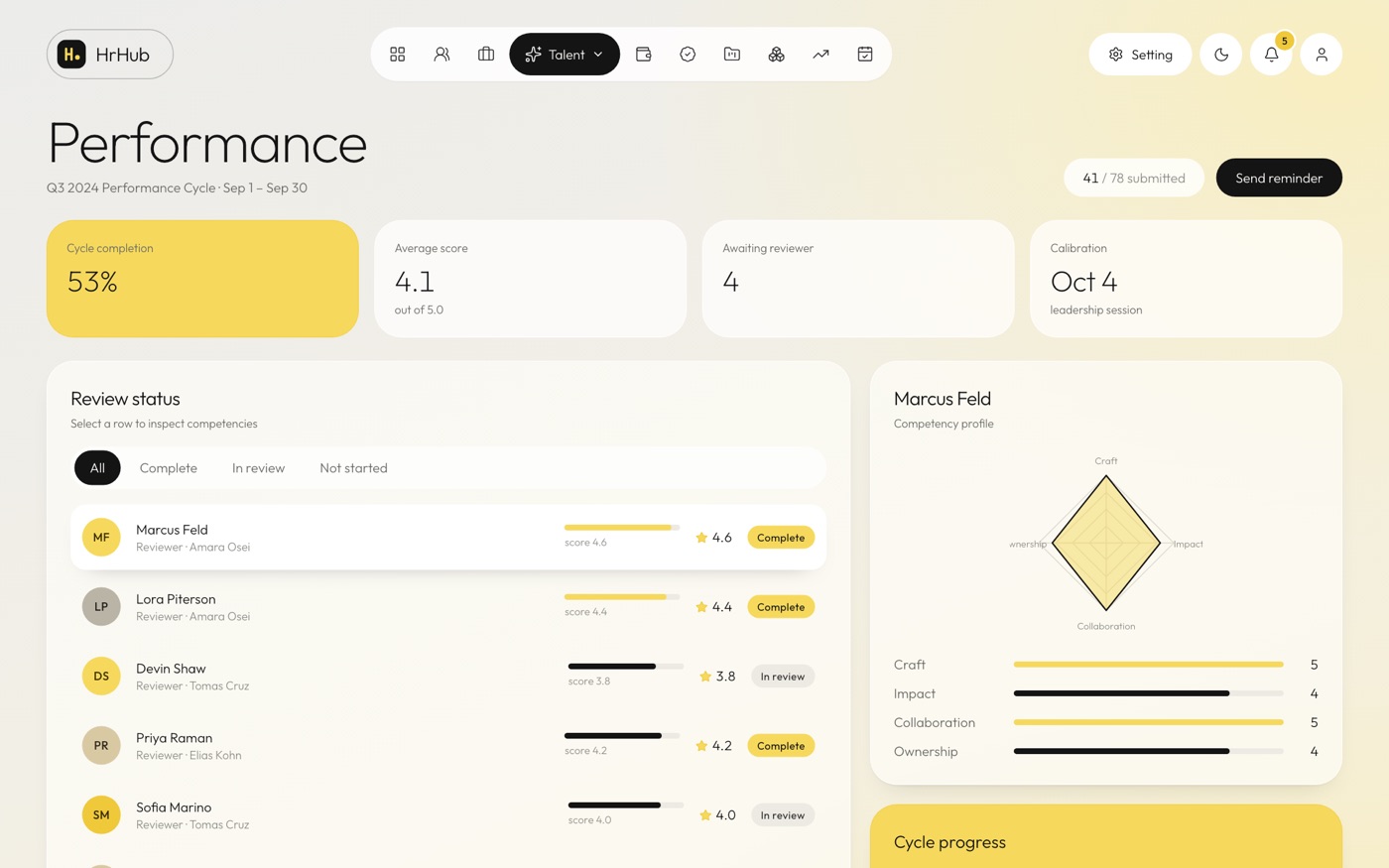
Headcount, turnover rates, cost-per-hire, department-wise leave trends — real-time dashboards replace the painful task of building pivot tables manually.
3. Excel vs HR Software: Process-by-Process Comparison
| HR Process | Excel | HR Software UAE |
|---|---|---|
| Payroll calculation | Manual, error-prone | Automated, WPS-ready |
| Leave management | Spreadsheet tracking | Self-service portal + auto-approval |
| Attendance | Manual entry | Biometric/GPS integration |
| Document expiry alerts | Calendar reminders (if set) | Automated notifications |
| Gratuity calculation | Formula-dependent | Built-in UAE law compliance |
| Onboarding | Checklist via email | Automated workflow |
| Reporting | Manual pivot tables | Real-time dashboards |
| Data security | Shared file access | Role-based permissions |
The honest answer? Excel can technically do most of these things. But it requires a skilled person to build and maintain the system, another person to verify accuracy, and yet another process to ensure nothing falls through when that person is sick or leaves the company.
HR payroll software UAE businesses use removes that single point of failure.
4. Payroll Compliance in the UAE — Where Excel Becomes a Liability
This section is worth reading carefully if you process payroll for ten or more employees in the UAE.
The Wage Protection System (WPS) requires companies to transfer salaries through approved channels and submit SIF (Salary Information File) data to the Ministry of Human Resources. Any errors in that file — wrong bank details, incorrect salary figures, missed entries — can trigger compliance flags and penalties.
Employee management software UAE-based companies rely on today generates WPS-compliant SIF files automatically, pulling data directly from the payroll module. In Excel? You're manually building that file every month, cross-referencing three different sheets, and hoping nothing is off by a decimal point.
Then there's gratuity. UAE Labour Law entitles most employees to end-of-service gratuity calculated on the basis of basic salary, length of service, and type of separation. The formula isn't complicated — but it is exacting. Get it wrong and you have a legal liability. Get it right across 200 employees every month while manually tracking start dates and salary history? That's where spreadsheets crack.
HR management system UAE companies are investing in handles all of this in the background — automatically, accurately, every time.
5. The Real Cost of Sticking with Spreadsheets
People often frame this as a cost comparison: "HR software costs X per month, Excel is free." That framing misses the actual calculation.
Consider what Excel-based HR management really costs:
Time cost. A single HR executive manually processing payroll for 50 employees in Excel typically spends 2–3 days per month on payroll alone. Good payroll software UAE solutions reduce that to a few hours.
Error cost. One incorrect payroll run can mean salary disputes, employee grievances, and WPS compliance issues. The time spent investigating and correcting errors is rarely tracked — but it adds up fast.
Turnover risk. When the person who built your HR spreadsheet system leaves, your processes leave with them. There's no institutional system — just institutional knowledge stored in one person's head and one unprotected file.
Compliance risk. UAE labour law evolves. When leave entitlements or gratuity rules change, your spreadsheet doesn't update itself. HR software vendors push these updates to the platform. You don't need to track it manually.
Scalability ceiling. Beyond a certain headcount, spreadsheet-based HR simply collapses under its own weight. Businesses that have tried to manage 100+ employees on Excel almost universally describe it as chaos.
6. When Should You Switch to HR Management System UAE?
There's no universal answer, but here are clear signals that the switch is overdue:
- You're processing payroll for more than 20 employees manually each month
- You've had at least one WPS compliance issue or salary dispute in the past year
- Your HR team spends more time on admin than on actual people management
- You can't pull a headcount or leave liability report in under 5 minutes
- Document expiry tracking is being done through calendar reminders or "tribal knowledge"
- Your business is scaling and you're onboarding more than 2–3 people per month
If three or more of those apply, the ROI on HR automation software UAE platforms offer is almost certain to be positive within the first quarter of use.
For businesses with under 20 employees that have relatively simple payroll structures, a hybrid approach can work: use HR software for payroll and compliance while keeping simpler tracking in spreadsheets. But be honest about when that line gets crossed.
FAQs
What HR processes can be automated with HR software in the UAE?
Payroll processing, WPS file generation, gratuity calculation, leave and attendance management, employee document tracking, onboarding workflows, performance appraisals, and HR reporting can all be fully automated using HR software UAE businesses typically adopt.
Is Excel good enough for payroll in the UAE?
For very small teams with straightforward payroll, Excel can work in the short term. However, as the team grows and WPS compliance requirements become more complex, the risk of errors and the time cost of manual processing make dedicated payroll software UAE a significantly safer and more efficient choice.
What is the WPS and how does HR software help with it?
The Wage Protection System (WPS) is a UAE government initiative that requires employers to pay salaries through approved financial channels and submit monthly salary data. Most HR payroll software UAE solutions generate WPS-compliant SIF files automatically, reducing the risk of compliance errors.
How much does HR software cost for a small business in the UAE?
Pricing varies widely depending on the platform and number of employees. Many human resource software UAE vendors offer per-employee monthly pricing, typically ranging from AED 15 to AED 60 per employee per month, with enterprise plans available for larger organisations.
Can employee management software integrate with UAE biometric attendance systems?
Yes. Most enterprise and mid-market employee management software UAE companies use supports integration with biometric attendance devices, access control systems, and GPS-based mobile check-ins.
Conclusion
Excel got a lot of UAE businesses through their early years — and there's no shame in that. But there's a point where the tool becomes the bottleneck, and for most growing businesses in the UAE, that point is around the 20–30 employee mark or the first serious compliance challenge.
HR software UAE businesses are adopting today isn't about replacing your HR team. It's about removing the low-value, high-risk manual work that eats their time — payroll calculations,
document chasing, leave approvals, WPS filings — so they can focus on what actually drives business: hiring better people, reducing turnover, and building a culture worth staying for.
The question isn't really whether to switch. It's whether you're still comfortable with the risk and inefficiency of not switching.
If you're evaluating HR management system UAE options, start with your biggest pain points — usually payroll and compliance — and work outward from there. The right platform will pay for itself faster than most business owners expect.